Neque Deus neque Natura: Śūnyatā, Spinoza, and the Monistic Trap
Buddhist metaphysics can be tricky. What is often trickier is reading it on its own terms.

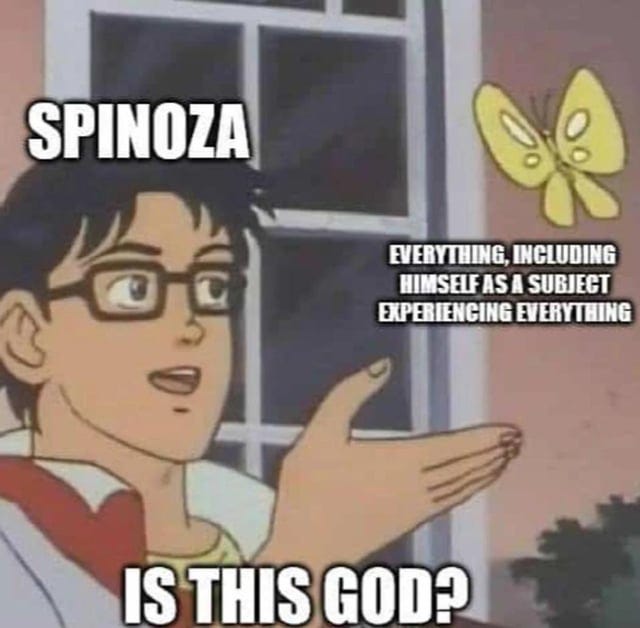
Hey beautiful people. I thought I’d just start uploading some stuff that I thought was pretty cool so that perhaps the algorithm starts potentially shining a favorable light on my future content sometime. This was a piece I wrote for a seminar in Buddhist philosophy responding to a common misinterpretation that I noticed followed those who were largely unfamiliar with Buddhist metaphysics but knowledgeable to a degree about topics in the history of Western philosophy. This is of course the false equivocation of Buddhist Śūnyatā with some kind of Western metaphysical analog—the frequent culprit being some kind of substance monism, especially Spinoza. While I am not altogether opposed with using analogs from different contexts as a heuristic to help understand an unfamiliar topic, it should be a damnable offense to assume that the East and West were only semantically different and were in fact talking about the same thing, using different words. I am of course (sort of) kidding, but I think that people who engage in cross-cultural philosophy ought to exercise a larger degree of hermeneutic sensitivity sometimes.
tl;dr—this post discusses Śūnyatā and why it is most definitely not a substance monism, and is in fact a novel model of metaphysics unique to its context and ought to be read as such on its own philosophical merits.
All engagement is welcome. As this is my first upload, I understand how toxic the Substack space can often be, but hey, who hasn’t engaged in a little bad faith keyboard warfare from time to time.
Also, rest assured. I don’t always write like this. I just wanted to finally put something—anything—out there.
While I was a student attending a seminar class on Buddhist philosophy, in a few discussions I have had with my peers, a question that has consistently bothered them to no end was how to make sense of śūnyatā as an absolute emptiness. On one hand, they will concede that the concept itself is logically incoherent and thereby reduces to just mere nihilism—perhaps even a “super nihilism” as I have heard it facetiously put once. On the other hand, I have observed a tendency to ascribe to it the place of an absolute, be it in the sense of a Hegelian sublative concrescence, or an impersonal God whose mind we exist within, and so on. In discussions about the nature of śūnyatā, it is rather commonplace to posit it as a Buddhist conception of the Absolute. This is to say that it is the eternal superstructure which instantiates all things pervasively in both the domain of conventional reality and ultimate reality. The overwhelming tendency, however, was a tendency to equate śūnyatā with some form of pantheism in the vein of Spinoza—in the sense that there is one, absolute, infinite substance and immanent reality exists merely as “modes” or “expressions” of this substance. While this is a convenient heuristic to perhaps demonstrate the dynamic relation śūnyatā has with ultimate, transcendental reality and immanent, conventional reality, it fails to account for the various metaphysical idiosyncrasies that Buddhist ontology puts forth, and one may even observe that a radically strong Spinozist account even rejects some of the core doctrines that are necessary for a Buddhist ontology.
Upon cursory readings of both Buddhism and Spinoza, one notices a plethora of thematic and conceptual similarities. Indeed, śūnyatā is not a substance monism, although there exist several idiosyncratic themes in Buddhist philosophy that may incentivize this correspondence. There are more than enough grounds to argue, however, that the philosophical incompatibilities present in both show a larger disparity than there is room to posit any high degree of similitude.
Falling into the Spinozist Trap: On the Erroneous Parallelism of Substance Monism and Śūnyatā
People fall into the Spinozist trap, in my experience, after responding to three problems, but the appeal of the Spinozist trap is firstly a response to another trap—that of Descartes. As Slavoj Žižek succinctly puts it, the Cartesian subject is the specter haunting Western academia.[1] Little does he know, the specter of Cartesianism has also sequestered itself neatly in the pages of Japanese philosophy and was the basis of Nishitani’s call for a reinterpretation of the relation of the subject and an absolute negation.[2] In the critical evaluation of Western sources by Buddhist thinkers, much work has been done to avoid such a trap. This “dualistic trap” manifests itself in the emphasis of selfhood as categorically distinct from any idealistic transcendence. In the face of nihility, we see the paradigmatic examples of the existentialists positing the self as a self-instantiating subject. While the West has found itself confounded by such a deadlock, the East has managed to free itself from the trap of dualism through śūnyatā by emphasizing the need for a new paradigm in delineating the relationship of the immanent and the transcendent. It would not suffice to merely posit the immanent as some kind of “provisional transcendent” such as in the case of Nietzsche and Sartre, nor would it suffice to posit a bilateral engagement of the world with the individual as immanent and the Absolute as transcendent. This has shown to introduce new problems, and one notices that these problems are the lures that attract so many people to Spinoza.
Firstly, there is the problem of how one makes sense of śūnyatā as transcendental. The Spinozist trap rests on the categorical error of situating śūnyatā at the level of God or the Absolute as a totally separate, categorically distinct thing. This is likely done to make sense of the view of śūnyatā as an absolute reality, and they ascribe properties that belong to God (e.g., omnipresence, etc.) onto śūnyatā. By itself, this is not so damning, however they do have to deal with the problematic dualism that this would entail. This leads me to the second problem—that of how śūnyatā engages with the domain of immanence. To remove the dualism from this equation, one would likely refer to longstanding Buddhist doctrines, particularly those of anatta or pratītyasamutpāda—the doctrines of no-self and dependent origination—as conditions that must be accepted to make sense of śūnyatā at the level of conventional reality. These two doctrines are essential to the Buddhist arsenal towards the elimination of the subject-object distinction, and simultaneously just as essential to the explication of śūnyatā.[3] This segues nicely to the third problem, which considers the question of what the immanent is. The intuitive claim here would be to posit that, insofar as to uphold the doctrine of no-self and dependent origination, śūnyatā is the pervasive reality on both the immanent and transcendent level. It unfolds itself qua its subjects, much like Spinoza’s Deus sive natura—the transcendence is interchangeable with the immanent, and the immanent is thus manifest as mere modes of the transcendent.
There are two main errors with this Spinozist interpretation of śūnyatā. The first one, and perhaps the more dangerous one, is the positing of a substance monism. The universe can be explained in terms of reducibility to a single substance—for the Spinozist reading, that of śūnyatā. This entails the second problem, which is that there is the total elimination of subjectivity, and this has consequences for positing any properties on the level of the immanent. The immanent is rendered little more than sub-transcendent (or even pseudo-transcendent) by virtue of the idea of God as nature, and thus fails to maintain any real level of distinction. Insofar then as we are mere extensions of śūnyatā, we do not need to concern ourselves with the question of being in the world, as the world and its beings are ultimately just śūnyatā manifest.
Getting Out of the Spinozist Trap: The Substantive and Subjective Dimensions of Śūnyatā
The thrust of the Spinozist trap is to respond to the reading of śūnyatā as a reductio ad nihilum, which ironically opens itself up to the problems mentioned above.[4] The genesis of such a reading lies in a fundamental misunderstanding of the emptiness that śūnyatā entails. Firstly, the “nothingness” of śūnyatā is not contrasted to “somethingness,” nor is it “mere nothingness” as negation. It is an absolute nothingness, and nothingness as negation is ontologically still “something.” This is to say that it stands contingently and in contrast to the existence of something. Secondly, śūnyatā, at least in its totality, is beyond conception and observability; it is rather comprehensible as something felt instead of known.[5]
We can observe, however, that śūnyatā as conceived of by Buddhist thinkers—particularly Keiji Nishitani and Masao Abe—can both respond to the former claim and absolve itself from the problems the Spinozist trap entails. This is due to a much-neglected condition of śūnyatā that entails absolute emptiness: boundless openness. The openness that śūnyatā entails is absolute, as Nishitani writes, and this openness ought to be conceived of parallel to interdependent origination.[6] Interdependent origination is situated in the existential paradox of being and emptiness (“How can something be when all things are empty?”), which Masao Abe explicates wonderfully in his Zen and Western Thought. Abe writes that insofar as we say that śūnyatā is the ultimate, all-pervasive constant of reality, then all things must be included in its scope—the “unrestricted dynamic whole.”[7] Śūnyatā is all things; all things are śūnyatā. This is about where the similarities with Spinoza end.
Things, however, retain their individuality and even maximize it as there is no “thing” to impede it in the standpoint of śūnyatā. This then points towards the concretizing of the quiddity of all things as well as the ontologically absolute freedom this entails. This is only possible if we foster a particular relationship with śūnyatā—not that of a modal extension like in Spinoza, nor a sublation in the sense of Neoplatonism or Hegel, but that of a standpoint with śūnyatā as the ground. Spinoza’s Absolute is nature, and therefore, it is both—to a degree—objectifiable and conceptualizable. Śūnyatā is however free from such restraints. Likewise, the situating of all things both as and in śūnyatā suggest that quiddity herein is not static, but infinitely dynamic and boundless.[8] This is not to say dynamic in terms of a Heraclitean flux—as we are grounded in śūnyatā—but something different altogether considering interdependent origination. Let us frame it in such a way: insofar as I (as no-self) am and in śūnyatā, then I can say that I (as ego) can really be me (as no-self) and vice versa; at the same time, due to the interpenetrative condition of interdependent origination, I am also involved in everything else’s processual origination. My quiddity as subject is therefore rendered empty, but this emptiness grants my subjectivity a higher-order quiddity, unrestrained by the fixity of mere particular being in the world.
It is this conception of quiddity that we can see is actively engaged in interdependent origination. Interdependent origination is absolutely contingent on the emptiness śūnyatā affords, as insofar as anything is unable to empty itself, its origination is constrained in terms of its openness.[9] An authentic, totalistic interdependence necessitates the need for nothing to be there, and likewise, nothing to be on the immediate horizon. It is then we can posit the concrete interrelation as that which is the true quiddity ex nihilo. Now, let us refer to the Spinozian model. The immanence of Spinoza’s ontology rests not so much on an interdependent origination, but rather a contingent essentialism. Insofar as all things are nature (and therefore God), then the constituents that make up nature do not interrelate nor ground each other’s ontology in this framework. This is because there is a fundamental essence that cannot at all be extirpated, which is that of God. The condition of openness is therefore severely constrained here, and the quiddity of nature is reduced to precisely be that of a singular monistic substance.
The Spinozist may say, according to Spinoza’s definition of a substance—that which is in itself and is conceived through itself—that śūnyatā is substance.[10] This is categorically false, as śūnyatā cannot be substance, since substance entails attributes, including that of some kind of particularization. Spinoza writes in the Ethics that God has two attributes: thought and extension. Thought here, is mere Being, borrowing from Parmenides.[11] The latter says things in the world are modes—extensions—of God. Our discussion on interdependent origination notwithstanding, this is an excellent opportunity to reveal that Spinoza’s ontology still subscribes to a duality, and the Spinozist trap fails to account for this shortcoming.[12] Spinoza’s God is the terminus of being, and insofar as we can ascribe attributes to it, it maintains a relative supervenience to something other than it. Śūnyatā cannot have attributes nor does it supervene on anything insofar as it is rendered relative to something. Also consider the eschatological implications. Spinoza’s God—and by extension, Hegel and other idealists—suggest a totalistic sublation wherein the particulars are subsumed into the Absolute One. Śūnyatā entails no such eschatology for three primary reasons. Firstly, śūnyatā is boundless, and it cannot be delineated as any sort of particularization. In addition to its abject lack of attributes and absolution from supervenience, we are not “sublated” into śūnyatā. Instead, we open ourselves up to śūnyatā as ground to concretize the interrelation of particulars simultaneously as śūnyatā and mediated by śūnyatā. Secondly, śūnyatā does not indicate the teleological elimination of individuality. Spinoza suggests that insofar as particulars are modes of God, then the subsumption of these modes by God will thus eliminate the particular modes of being that these embody. As we have discussed earlier regarding quiddity, śūnyatā does not eliminate modes of being, nor does our opening up to it result in such elimination. Particulars are not modes of śūnyatā, but rather, through interdependent origination, śūnyatā generates, enables, and mediates our particular modes of being. Thirdly, śūnyatā is absolutely non-dualistic. This to say that śūnyatā is not an Absolute One relative to things in the world; it is not a categorically distinct thing. It does not maintain any strictly contingent or necessary relation to particulars. How we should conceive of the relationship of śūnyatā and particulars then is that of a interdependent origination towards absolute possibility. Abe, on a comparative study of Spinoza and Dōgen, says it quite nicely: “For Dōgen, all beings are ‘swallowed up’ bottomlessly by the Buddha-nature; yet at the same time the Buddha-nature is also ‘swallowed up’ bottomlessly by all beings.”[13], [14]
Affirmation qua Negation: Keiji Nishitani’s Boundlessly Open, Affirmative Śūnyatā
Philosophical writings on śūnyatā in Buddhist literature highlight some other fundamental incompatibilities between śūnyatā and Spinoza. A Buddhist philosopher who has dealt extensively, if not almost exclusively, with the definition and explication of śūnyatā and its philosophically adjacent topics was Keiji Nishitani. In Religion and Nothingness, Nishitani follows a similar line of thought as that of Abe, who was Nishitani’s student. Śūnyatā maintains a relationship with the immanent subject that does not reduce to a mere modal extension of the absolute. From the standpoint of śūnyatā we in fact concretize our suchness as human beings whilst simultaneously concretizing the world around us.[15] There is a distinctly affirmative aspect of śūnyatā then that cannot be neglected—in Nishitani’s words, a “Great Affirmation.” This points towards śūnyatā as not a purely negative category and having a dimension of distinct affirmation through boundless openness. Borrowing from Nietzsche, Nishitani writes, in his detailed comparison of śūnyatā and nihility, that the field of śūnyatā is that of “be-ification” and absolute affirmation, “where we can say Yes to all things.”[16] What is meant by this affirmative dimension is to “have a hold on oneself” or to “self-affirm” insofar as to concretize one’s own immanence as pure Becoming—where “each thing becomes manifest in its suchness in it its very act of affirming itself, according to its own particular potential and virtus and its own particular shape.”[17]
If we are to accept śūnyatā as only emptiness, then it would quite simply just be mere nihilism.[18] Śūnyatā must have this transformative, affirmative dimension, and therein we can better reorient ourselves to examine the facticity of immanence and transcendence, of particular and universal, or to use Nishitani’s terms, the “near” and “far” sides. The affirmative dimension of śūnyatā allows us to see the universal as something not only beyond us, but something we have arrived at.[19] Thus, śūnyatā qua Great Affirmation unifies this ostensible dualism and concretizes the particular, rendering it universal. For Nishitani, this is only arrived at after passing through the field of negation, which śūnyatā of course also entails. Only after we remove something do we have the space to place something else.
This is an absolutely salient point with respect to the negative dimension of śūnyatā and interdependent origination. Interdependent origination, as we have shown, requires the nihility afforded by śūnyatā, and only then can we have an authentic interdependence. The lack of self that precludes interdependent origination also denotes a lack of etiological limitation, and herein we see how the no-self is important. Only if we extirpate such a pre-given condition by passing through the field of nihility first can we pursue the Great Affirmation that śūnyatā mediates vis-à-vis interdependent origination. As such, we can observe that there is an intimate relation between the affirmative and negative dimensions of śūnyatā herein. The point I would like to elucidate here, however, is to show that such a transformative dimension is totally absent in Spinoza. The God of Spinoza only affirms onto itself, and we notice ontological constraints on two levels here: one regarding the etiological and teleological dimensions, and one on the ontological and mereological ones. Spinoza’s God can, in other words, only build on what is already there, and nothing absolutely or radically new is created in its stead. It is then either a totalizing immanence or a constrained transcendence, not to mention fundamentally incapable of accounting for (or transcending) such duality.
Conclusion: Future Directions for the Comparative Philosophy of Śūnyatā
Let us attempt to save people from falling into the trap by introducing and pointing towards better Western analogues to śūnyatā. In Buddhism and Interfaith Dialogue, Masao Abe writes that what any śūnyatā-minded religious adherent must do is locate the figure behind the God abstracted, the true God, by going beyond and realizing the finitude of the abstracted God.[20] While Abe and Nishitani’s excellent analogue of Eckhart and the Gottheit would suffice insofar as it demonstrates the absolute affirmation qua negation (in Abe’s view, the authentic fulfillment of the kenosis of God through the negation of the particular categories of the Trinity in order to affirm the Godhead), the picture it paints is quite incomplete on its own as it fails to account for interdependent origination.[21] A far better example is that of process theology, particularly the view that God is “pure creativity.” This view, popularized by John Cobb, Jr., posits that God is creativity as such, and this accounts for both the formlessness, impersonality, and boundlessness that śūnyatā necessitates. This, then, is a panentheism—a religious model that posits the mutual interdependence of God and the world—instead of a monistic pantheism.[22] In such a model, God interdependently originates through the world (insofar as the creative act must be possible) and the world interdependently originates through God (by manifesting the creative act).[23] This model, for instance, succeeds, at least prima facie, in avoiding all the philosophical baits that would cause one to fall into the Spinozist trap. There is however a better solution.
As tempting as it would be to attempt to make sense of the mystery of śūnyatā by drawing comparison to the comprehensive substance monism of philosophers such as Spinoza, it fails to account for certain nuances surrounding śūnyatā and Buddhism writ large. To this extent, one ought to be careful when drawing comparisons so as not to fall into traps. There are, of course, things in the West that śūnyatā conceptually may be similar to, but much more of what it is not. A suggestion for future endeavors, perhaps, is to altogether resist the temptation of drawing analogies from more established canons of philosophy and instead to read and understand śūnyatā on its own terms, without the heuristic filter of Western philosophy. Perhaps only then, through the negation of the temptation, can we affirm the profound truth that śūnyatā seeks to bring forward.
BIBLIOGRAPHY
Abe, Masao. Zen and Western Thought. Edited by William R. LaFleur. London: Macmillan Press, 1985.
—. Buddhism and Interfaith Dialogue: Part One of a Two-Volume Sequel to Zen and Western Thought. Edited by Steven Heine. London: Macmillan Press, 1995.
—. Zen and Comparative Studies: Part Two of a Two-Volume Sequel to Zen and Western Thought. Edited by Steven Heine. London: Macmillan Press, 1997.
Bonting, Sjoerd Lieuwe. Creating and Double Chaos. Minneapolis: MN, Fortress Press, 2005. Kindle edition.
Culp, John. “Panentheism.” Stanford Encyclopedia of Philosophy. (2023). Accessed from https://plato.stanford.edu/entries/panentheism/.
Keown, Damien. A Dictionary of Buddhism. Oxford: Oxford University Press, 2004.
Nishitani, Keiji, Religion and Nothingness. Translated by Jan van Bragt. Berkeley, CA: University of California Press, 1982.
Spinoza, Benedict de. “The Ethics (Ethica Ordine Geometrico Demonstrata,” Project Gutenberg. (2009). Accessed from https://www.gutenberg.org/files/3800/3800-h/3800-h.htm.
Žižek, Slavoj. The Ticklish Subject: The Absent Centre of Political Ontology. London: Verso Books, 1999.
[1] Slavoj Žižek, The Ticklish Subject (London: Verso Books, 1999).
[2] Jan van Bragt, “Foreword,” in Religion and Nothingness (Berkeley, CA: University of California Press, 1982), xiv.
[3] Jan Van Bragt, “Translator’s Introduction,” Religion and Nothingness (Berkeley, CA: University of California Press, 1982), xxv.
[4] Ibid.
[5] Masao Abe, Zen and Comparative Studies, ed. Steve Heine (London: Macmillan Press, 1997), 141.
[6] Keiji Nishitani, Religion and Nothingness, trans. Jan van Bragt (Berkeley, CA: University of California Press, 1982), 105.
[7] Masao Abe, Zen and Western Thought, ed. William R. LaFleur (London: Macmillan Press, 1985), 161.
[8] Ibid. 162.
[9] Abe, 1997, 141.
[10] Benedict de Spinoza, “The Ethics,” Project Gutenberg, trans. R.H.M. Elwes, 2009, https://www.gutenberg.org/files/3800/3800-h/3800-h.htm.
[11] Nishitani, 1982, 143.
[12] Abe, 1985, 38.
[13] Ibid. 40.
[14] Buddha-nature here is used synonymously with śūnyatā. This was common practice in writings in Mahayana Buddhist traditions. See Damien Keown, A Dictionary of Buddhism (Oxford: Oxford University Press, 2004).
[15]Nishitani, 1982, 137.
[16] Ibid. 124.
[17] Ibid. 131.
[18] Ibid. 138.
[19] Ibid. 138.
[20] Masao Abe, Buddhism and Interfaith Dialogue, ed. Steven Heine (London: Macmillan Press, 1995), 33 – 34.
[21] Ibid. 33.
[22] John Culp, “Panentheism,” Stanford Encyclopedia of Philosophy, 2023, https://plato.stanford.edu/entries/panentheism/.
[23] Sjoerd Lieuwe Bonting, Creation and Double Chaos (Minneapolis, MN: Fortress Press, 2005), Kindle edition, 1250.
We’ve been trying to escape duality over here (West) since Plato. Haven’t succeeded, and no one will, I think.
I’m trying to relate this in terms of Heidegger. In context of Spinoza and Sūnyatā, can we see Heidegger as an example of some reach for non-duality in studying Sein through Dasein? I know Heidegger interacted with some Buddhists and it didn’t go well….